Cities are living maps of human intention.
From the café where commuters grab their morning coffee, to the shopping mall that shapes weekend routines, to the gym that defines after-work habits, these Points of Interest (POIs) are more than just physical locations. They are touchpoints of daily life that show how people move, connect, and make decisions.
For businesses, POIs are not just spots on a map. They are the settings where consumer behavior is created, influenced, and acted upon. Understanding POIs means understanding where demand exists and how decisions are made in the real world.
What Is a Points of Interest?
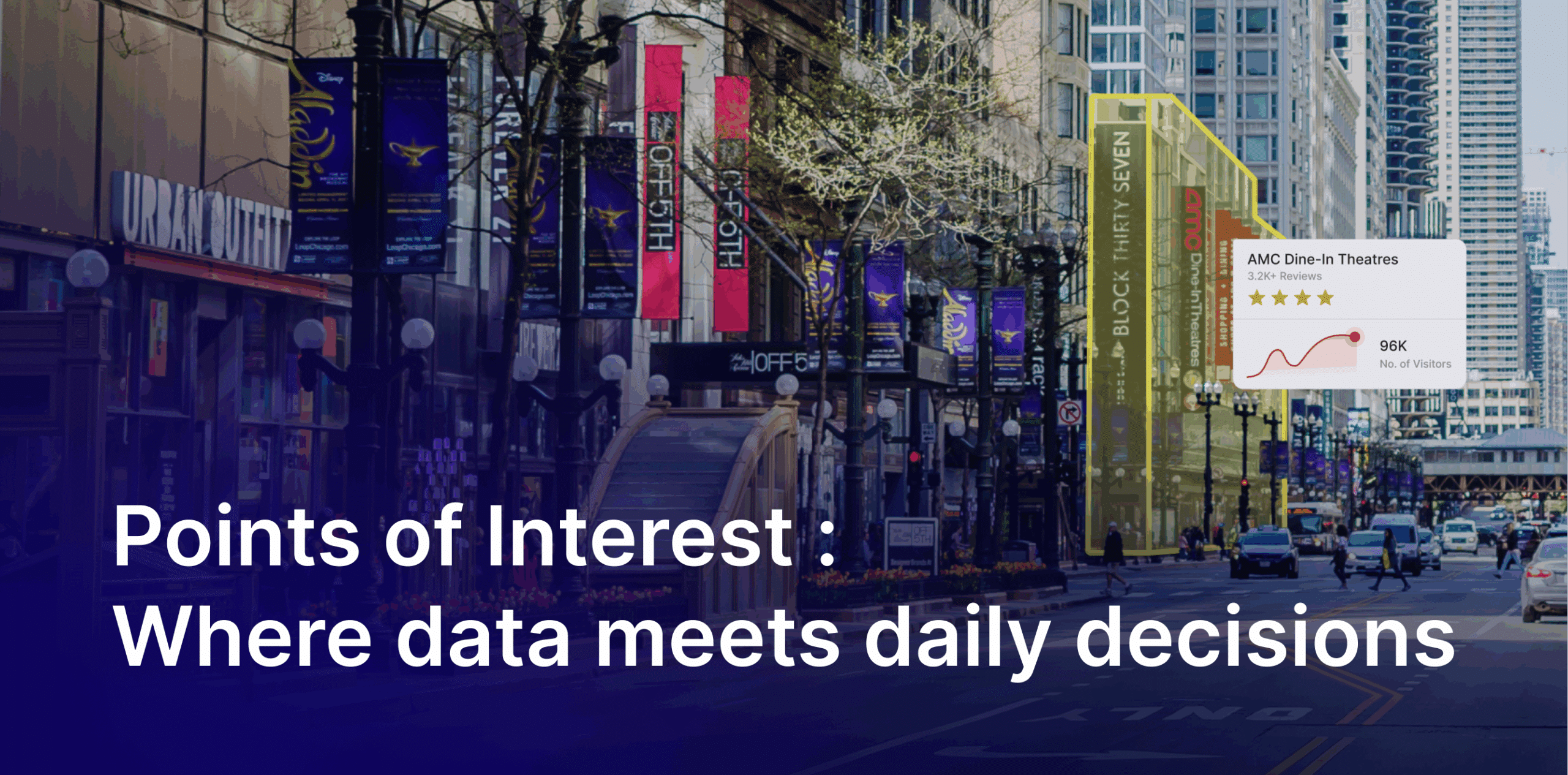
A Point of Interest (POI) is any location that holds value for people in their day-to-day lives.
POIs can be:
- Commercial: restaurants, retail stores, supermarkets, banks
- Recreational: gyms, parks, cinemas, stadiums
- Cultural: museums, libraries, historical landmarks
- Essential services: hospitals, pharmacies, schools, transit stations
While the idea seems simple, the impact of POIs is significant. Each one represents a point of consumer engagement—a moment when choices are made and habits are formed.
POIs are not just destinations, they are decision-making environments.
Think about it:
- The coffee shop that becomes part of a commuter’s daily routine
- The shopping center where families spend weekends
- The stadium that gathers thousands of people at once
Understanding POIs means understanding context: what people do, why they do it, and how those actions connect to business opportunities.
Why Points of Interest Matter to Businesses?
Businesses often analyze customers through demographics or digital behavior. However, these insights remain incomplete without understanding where those customers spend their time.
POIs provide that missing context.
1. Retail and Hospitality
Store success depends heavily on location context.
- A bookstore near a university benefits from student demand
- A café near a transit hub captures commuter flow
- Hotels near airports or attractions see higher occupancy
Businesses aligned with the right POIs tap into existing consumer routines.
2. Brand Visibility and Relevance
Consumers make decisions based on their surroundings.
Being present near key POIs ensures a brand is visible at the moment decisions happen.
3. Real Estate and Expansion
Businesses don’t just ask “where is space available?”
They ask: “where do people already gather?”
POIs help reduce expansion risk and improve long-term success.
4. Consumer Behavior Insights
POIs reveal lifestyle patterns.
- Gym + organic store visits → health-focused behavior
- Mall + fast food visits → convenience-driven behavior
POIs connect location with behavior, giving businesses deeper customer understanding.
Explore Factori’s foot traffic data to understand how people move between POIs and uncover deeper consumer behavior patterns.
Read About: How POI Data is shaping up Advertising and Marketing
How Businesses Use POIs
Businesses use POIs to translate location data into strategic decisions:
Step 1: Identify Relevant POIs
Focus on locations aligned with your target audience
Step 2: Analyze Activity Patterns
Study footfall, timing, and surrounding context
Step 3: Evaluate Competition
Understand competitor density and proximity
Step 4: Apply Insights
Use findings for site selection, marketing, and operations

Strategies for Leveraging POIs
POIs themselves are not just static places; they are active environments that businesses can use strategically across different industries. Here’s how organizations are putting them to work:
1. Align with Consumer Routines
Understanding the POIs that shape daily life allows businesses to position themselves where they naturally fit. A pharmacy near a residential community center becomes the go-to for quick prescriptions. A gym surrounded by healthy food outlets supports a lifestyle focus.
2. Anchor Around High-Traffic Hubs
Transit stations, airports, and shopping malls aren’t just POIs; they serve as gathering points. Businesses located here gain access to built-in crowds. This is why convenience stores and quick-service restaurants cluster around train stations and highways.
3. Create Experiences Within POIs
Brands don’t always need their own physical stores to benefit from POIs. Pop-up shops inside malls, sponsorships at stadiums, or brand activations in parks turn POIs into engagement platforms. These temporary setups tie brand visibility directly to the moments when people are ready to interact.
4. Compete Through Proximity
Sometimes, success comes from being near the right POIs instead of being the POI itself. Restaurants often position themselves close to cinemas to attract diners before or after movies. Fitness apparel brands set up near gyms. Being close builds relevance without requiring changes in habits.
5. Enhance Customer Experience
Businesses can design services around the POIs that matter most to their customers. A coffee chain near an office district might offer subscription models for daily commuters. A hotel near a stadium might create special packages for game-day travelers. When brands consider POIs, they align customer experience with consumer needs.
Read About: Texas Point of Interest for Business Owners
The Future of Points of Interest (POI)
As cities evolve and consumer lifestyles shift, the role of POIs is becoming even more central to how businesses think and act.
1. Changing Urban Landscapes
New POIs emerge as cities grow. These include coworking spaces, electric vehicle charging stations, and wellness centers. Each of these offers brands a new chance to connect with people in meaningful ways.
2. Integration with Technology
While the focus here is on POIs themselves, it’s undeniable that technology will shape how businesses engage with them. Mobile apps, AR experiences, and smart city infrastructure will increasingly tie digital interactions to physical POIs.
3. Blending Categories
POIs are not just for one purpose anymore. A bookstore can also serve as a café and coworking space. A stadium may host concerts as well as sporting events. These mixed-use POIs create new ways for engagement, giving businesses several points of connection at one site.
4. Evolving Consumer Expectations
Consumers want seamless experiences. They expect the restaurant near the theater to know when shows end, and the café near the office to prepare for the morning rush. Businesses that view POIs as not just locations but as patterns of human behavior will stand out.
How Factori Help You with POI Datasets?
At Factori, we help businesses unlock the value of Points of Interest data with reliable, privacy-compliant datasets. As a top global POI provider, we give access to over 200 million POIs worldwide, trusted by more than 300 companies in various industries.
Using machine learning, our solutions find and verify millions of POIs while assessing their performance. This way, you always have the most trustworthy insights. We focus on data security, adhere to the highest compliance standards, and provide datasets in flexible formats that suit your needs.
See how to evaluate and choose the right POI data provider for your business needs.
Our mission is straightforward: to be the preferred data partner for businesses seeking a competitive edge in today’s AI-driven world.
About Factori
Factori is a partner-powered real-world data platform offering 13 standardized, enterprise-ready datasets including:
Mobility | Places | People | Audiences | Identity | Retail | Market | Economic | Events | Property | Business I Geo.
Each dataset is governed, privacy-safe, and designed to join cleanly with your existing data stack, whether you’re working in SQL, a data warehouse, a BI tool, or an ML pipeline. No black boxes, no mystery sources, just real-world signals about how people move, shop, work, and live, delivered the way your team works: via API, raw data, app, MCPs, or agentic workflows. Explore datasets suitable for your use case and available for your market.
Talk to an Expert Get Started
Conclusion
Points of Interest are more than physical places — they are the anchors of consumer life. They shape where people go, how they spend their time, and the decisions they make along the way.
For businesses, understanding POIs means understanding context: not just who your customers are, but where their lives actually happen. From retail and hospitality to real estate and city planning, POIs provide the foundation for strategies that align with real-world behavior.
Learn how location intelligence for business growth can help you turn POI insights into competitive advantage.
Today, POIs are already central to how companies make decisions — from selecting store locations to designing marketing campaigns. The businesses that succeed are the ones paying close attention to the places people value most, and aligning their strategies to meet customers there.
FAQs
What is a Point of Interest (POI)?
A Point of Interest is a real-world location that people find useful or meaningful, such as a store, park, or transit hub.
Why are POIs important for businesses?
POIs help businesses understand where customers go, identify demand patterns, and make better decisions about location, marketing, and operations.
How do businesses use POI data?
Businesses use POI data for site selection, customer insights, competitive analysis, and improving operational strategies.
What industries benefit from POI data?
Retail, hospitality, logistics, real estate, marketing, and urban planning all use POI data.
How does POI data improve decision-making?
POI data provides real-world context, helping businesses align strategies with actual consumer behavior instead of assumptions.