
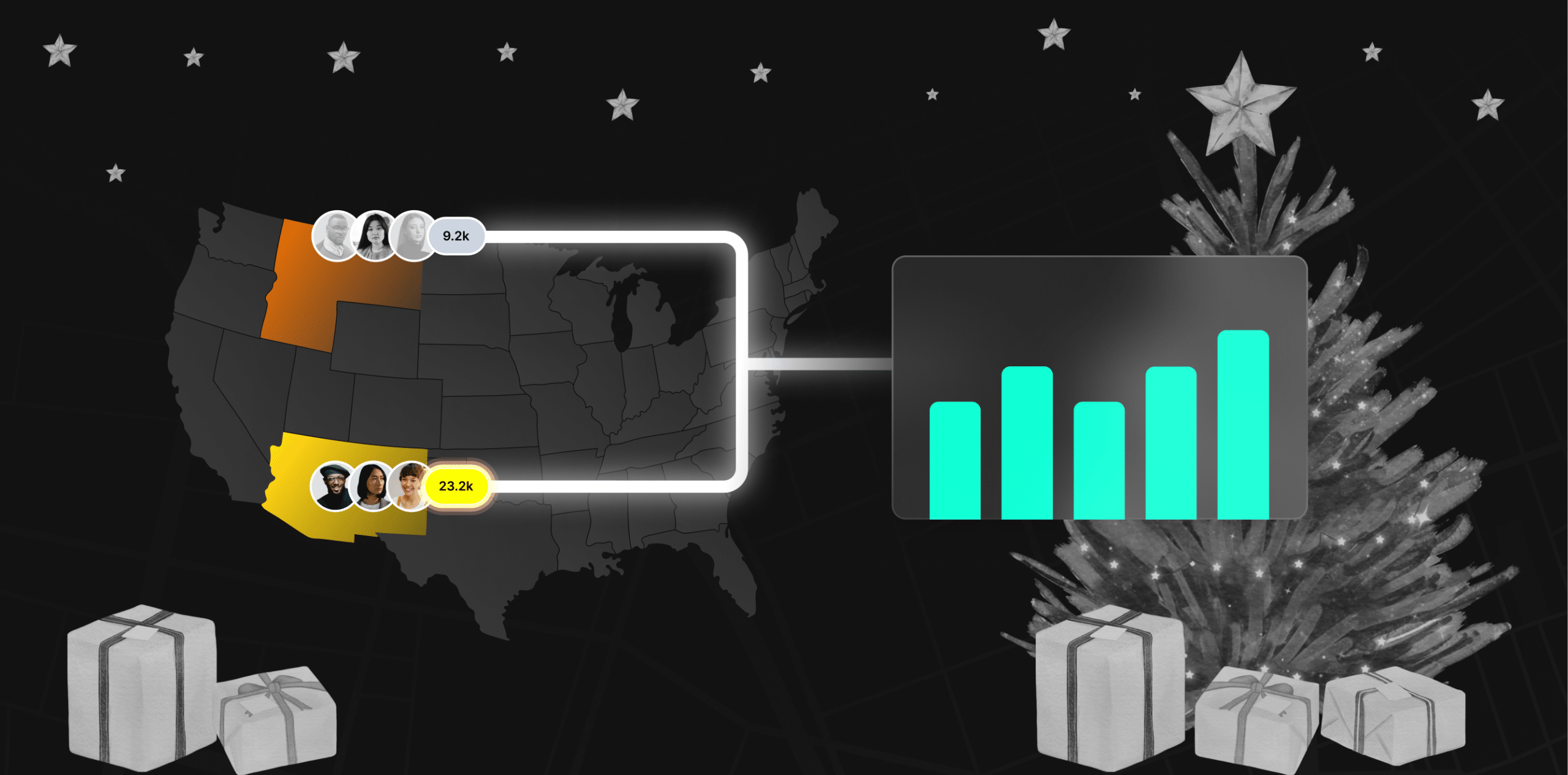
Holiday marketing is noisy, expensive, and brutally local. Same national campaign. Same discount. Same creative. Completely different results between two stores five miles apart.
One is beside a stadium with three sold-out games, a tree-lighting ceremony, and perfect December weather.
The other is in a commuter suburb with roadworks, freezing rain, and a new competitor that just opened across the street.
If your media plan and your store-level decisions don’t “see” those differences, you’re leaving margin, inventory, and customer experience on the table.
Modern geo-targeting strategy solves this not by drawing a circle around a store, but by using real-world signals to understand which neighborhoods are heating up, softening, congested, event-driven, or price-sensitive.
This is where modern geo-targeting – powered by real-world signals, not just ZIP codes changes the holiday game.
Read about: Geofencing Marketing
Why geo-targeting strategies matter more than ever in the holidays
Holiday spend is omnichannel, but it’s still deeply physical:
- In 2025, only ~19% of global retail sales are online; the rest still happens in stores.
- In the U.S., ~80–84% of retail sales are expected to occur in brick-and-mortar stores in 2025.
- During the 2024 holiday period, online spend hit records, but most payments (77%) were still made in physical stores.
Ecommerce is huge, but what determines holiday performance is still what happens in real places—parking lots, trade areas, malls, and main streets.
And CPMs rise sharply during November–December.
Holiday CPMs often run 20–40% higher than the yearly average across major ad platforms, increasing the cost of wasted reach.
For retailers and brands, that has three big implications:
- Holiday demand is hyper-local. Weather shifts, event weeks, school calendars, and traffic patterns can make some stores explode while others stay flat.
- Media without geo-ops alignment is risky. Driving more traffic to already constrained stores (parking, staff, BOPIS capacity) can hurt NPS and shrink margin.
- Generic “holiday audiences” are increasingly expensive. Precision about where and when you lean in becomes a competitive advantage when acquisition costs are at their peak.
Most retailers today still fall into a few pitfalls:
- Flat national promos
- Generic creative
- Uniform budgets
- No link between media and operations
- No connection between neighborhood economics and discount depth
Geo-targeting isn’t just “show this ad within 10 miles of a store.”
It’s using real-world signals to decide which neighborhoods, which weeks, which stores, and which customers deserve which message and which budget.
The new data toolbox for holiday geo-targeting
To move beyond blunt radius targeting, you need a stack of spatiotemporal datasets that describe what’s actually happening around each store or trade area.
The holiday season is dynamic and volatile and data freshness matters. Events change crowds by the hour, and competitive openings/closures can reshape markets in weeks. High-recency signals improve both accuracy and ROI.
Here are the core, normalized indices that plug directly into media, forecasting, and store operations workflows:
- Events
Aggregated signals for concerts, sports, festivals, school breaks, and local happenings around each store or catchment by day.
- Use it to: Identify “event weeks” where you should lean into footfall, extend hours, or localize creative.
- Use it to: Identify “event weeks” where you should lean into footfall, extend hours, or localize creative.
- Weather
How today’s weather deviates from normal (e.g., “10°F colder than usual,” “unseasonably warm & rainy”).
- Use it to: Adjust creative and offers (hot drinks vs iced, comfort food vs salads) and recalibrate perishables orders.
- Use it to: Adjust creative and offers (hot drinks vs iced, comfort food vs salads) and recalibrate perishables orders.
- Traffic
A measure of road congestion and disruption (incidents, roadworks, game‑day patterns) around each location.
- Use it to: Decide where curbside/BOPIS messaging could backfire, and where you should pre‑warn about delays.
- Use it to: Decide where curbside/BOPIS messaging could backfire, and where you should pre‑warn about delays.
- Footfall
Aggregate, privacy‑safe indices of how busy an area is compared to normal, without relying on device‑level tracking.
- Use it to: Spot “up‑and‑to‑the‑right” neighborhoods worth heavier spend, and softening corridors where you might protect margin.
- Use it to: Spot “up‑and‑to‑the‑right” neighborhoods worth heavier spend, and softening corridors where you might protect margin.
- Competitive Density & POI Churn
Normalized views of how many competing (and complementary) stores exist around you, and which have opened or closed recently.
- Use it to: Shift budget to “winnable” markets where a competitor just closed, or defend where a new rival just launched a store.
- Economic
Micro‑market economic health indicators (affluence, employment, inflation exposure) that shape price sensitivity and basket mix.- Use it to: Vary discount depth, messaging, and product focus by neighborhood.
Which signals solve which holiday problems?
| Holiday Problem | Best Signals |
| Event-driven surges | Events + Traffic + Footfall |
| Weather-sensitive categories | Weather Delta + Footfall |
| Pickup congestion | Traffic + Footfall + Internal capacity |
| Competitor openings/closures | POI Churn + Footfall |
| Price sensitivity | Economic Pulse + Footfall |
All datasets must join cleanly to stores and trade areas using open IDs (e.g., GERS) or standard GeoIDs—privacy-safe, leakage-safe, and interoperable.
Five high-impact geo-targeting plays for holiday retail
Below are expanded versions of each play, including added operational nuances and KPIs for measurement.
Play 1: Micro‑climate holiday offers (weather‑aware geo‑targeting)
Problem: The same blanket “Holiday Warm-Up Sale” runs nationally but half your northern stores are dealing with ice storms, while southern stores are in T‑shirt weather.
Signals to combine
- Weather Delta (vs seasonal norms)
- Footfall Index
- Category‑level sensitivity (e.g., soup, hot beverages, coats vs. cold drinks, grills)
How to execute
- Cluster stores by weather pattern, not just by region (e.g., “unseasonably cold & dry,” “wet & warm,” “normal”).
- Build geo‑targeted creatives for each cluster:
- Cold: “Warm up for less tonight – Category X 20% off near you”
- Warm: “One more weekend on the patio? Stock up before the chill hits.”
- Weight budgets toward clusters with:
- Large positive Weather Delta
- Sufficient inventory and staffing (from your internal data).
Why it works
Weather is one of the strongest, most immediate demand drivers for grocery, convenience, apparel, and QSR. By leaning into the delta vs normal, you capture spikes where they actually happen, not just where the calendar says they should.
Play 2: Event‑driven “halo store” targeting
Problem: Big events (games, concerts, festivals) create huge, but uneven, demand. Some stores are in the “halo” and get slammed; others stay quiet.
Signals to combine
- Event Intensity (by day + radius around the venue)
- Traffic Stress
- Footfall Index
- Store rings / drive‑time polygons
How to execute
- For each event, map first‑ and second‑ring stores (e.g., 5–10 minute drive or walk).
- Use Event Intensity + Footfall Index to score each store/event day combo:
- High intensity, high baseline footfall = priority surge stores.
- High intensity, high baseline footfall = priority surge stores.
- Create geo‑fenced campaigns for surge stores:
- Messaging: “Headed to the game? Skip the lines – grab your snacks here first.”
- Timing: Pulse spend in the 6–8 hours before the event start.
- Coordinate ops:
- Increase staff, orders for key categories (fuel, beverages, prepared foods).
- Adjust hours if needed.
Why it works
Instead of “we heard there’s a game in this city,” you’re acting on which exact stores will see uplift and when. That turns events into an orchestrated play, not a lucky accident.
Play 3: BOPIS/BOPAC‑aware media
Problem: Holiday customers love BOPIS/BOPAC, but your pick/pack capacity is finite. Over‑promoting pick‑up at constrained stores leads to missed SLAs and bad reviews.
Signals to combine
- Traffic Stress (around store and key feeder roads)
- Footfall Index
- Internal: BOPIS slot utilization, pick/pack capacity, average ready‑time
How to execute
- Build a “capacity pressure” score by store/day:
- High traffic stress + high baseline footfall + high BOPIS utilization = red.
- Low stress + underutilized slots = green.
- For green stores:
- Geo‑target messaging: “Skip the holiday chaos – reserve online, pick up in 2 hours at the store.”
- Increase local performance budget.
- For red stores:
- Dial back BOPIS‑specific creatives; emphasize in‑store experiences, off‑peak hours, or alternative locations nearby.
- Adjust slot caps and staffing internally.
Why it works
Most retailers optimize media for demand, not serviceability. This play ties geo‑targeting to operational reality, protecting both margin and NPS.
Play 4: Competitor opening/closure “strike zones”
Problem: New competitor stores or sudden closures change local demand patterns, especially ahead of the holidays—but most media plans don’t react.
Signals to combine
- Competitive Density
- POI Churn (who just opened/closed)
- Footfall Index trends
- Economic Pulse
How to execute
- Use POI Churn to detect markets with recent competitor closures or bankruptcies.
- Score nearby stores by:
- Distance to the closed site
- Footfall Index trend (are they already absorbing traffic?)
- Create “strike zone” segments:
- For stores likely to gain share: invest in conquest messaging and retention offers.
- For stores near new openings: defensive offers, loyalty pushes, and differentiated experiences.
- Tie into promo strategy:
- Deeper offers and broader reach where share is up for grabs and margins can support it.
Why it works
You stop treating the country as flat and instead hunt where the competitive puck is moving, store by store.
Play 5: Economic Pulse‑driven creative & offer strategy
Problem: Inflation and macro uncertainty don’t hit every neighborhood equally. Yet many holiday campaigns assume a uniform level of price sensitivity.
Signals to combine
- Economic Pulse (local affluence/strain indicators)
- Footfall Index
- Basket and margin structure (internal)
How to execute
- Segment stores into micro‑market “moods”:
- Value‑stressed: more price‑sensitive; looking for deals.
- Middle: mixed, selective splurges.
- Affluent: less discount‑driven, more convenience/experience‑driven.
- For value‑stressed segments:
- Geo‑target heavier discount messaging, clear price points, and value packs.
- Emphasize essentials, bulk, and private label.
- For affluent segments:
- Focus on convenience (same‑day, BOPIS), limited editions, gifting, and premium bundles.
- Focus on convenience (same‑day, BOPIS), limited editions, gifting, and premium bundles.
- Coordinate inventory:
- Align depth of deals and assortment with local elasticity instead of a national “flat” strategy.
Why it works
You stop shouting the same discount into every neighborhood and start matching offer, message, and margin strategy to local wallets.
A practical blueprint: how to actually run this for the holidays
A more detailed, execution-ready sequence:
Step 1 – Align on objectives and constraints
- Regional/store revenue and margin targets
- Staff availability, pick/pack limits, parking constraints
- Guardrails: promo caps, media spend ceilings
- Sensitive locations to automatically exclude
Step 2 – Define geographies & join keys
- Choose whether to plan at store level, cluster, DMA, or trade area
- Standardize to open IDs and GeoIDs (GERS, Placekey, census shapes)
- Ensure leakage-safe joins for mobility/footfall signals
Step 3 – Pull and engineer real-world features
For each store/trade area by day/week:
- Event intensity
- Weather delta
- Traffic congestion
- Footfall
- Competitive density & POI churn
- Economic indicators
Convert these into simple interpretable indices:
- Holiday Event Surge Score
- Weather Tailwind Score
- BOPIS Risk Score
- Share-Up-For-Grabs Score
Step 4 – Build a geo-targeting playbook matrix
Create a matrix that says:
| Store/Trade Area Type | Real‑world pattern | Media move | Ops move |
| High events, high capacity | Big Event Intensity, low Traffic Stress, low capacity utilization | Increase bids, expand radius, event‑themed creative | Add staff, increase orders for key categories |
| High events, low capacity | Big Event Intensity, high Traffic Stress, high capacity utilization | Keep budgets flat; emphasize off‑peak hours or digital alternatives | Add staff if possible; manage queues and slots |
| Low events, strong economic pulse | Low Event Intensity, high Economic Pulse | Focus on premium gifting and experiences | Curate premium assortments, services |
| Competitor just closed | High positive POI Churn, strong baseline Footfall | Conquest targeting, new‑customer offers | Ensure inventory depth; capture new regulars |
This becomes your shared source of truth across media, ops, and analytics.
Step 5 – Activate in your channels
- Paid Social & Display: Push store/cluster audiences; map creative variants to real-world segments.
- Search & LIA: Adjust bids around event days and weather anomalies.
- Email/SMS/App: Localize subject lines and promos to store assignment + trade area patterns.
Holiday execution benefits from a weekly (or twice-weekly) refresh of all indices.
Step 6 – Measure properly (and prove the value)
- Use geo-matched test vs. control stores
- Track:
- Incremental sales
- Stockouts
- BOPIS SLA adherence
- Queue times
- Labor variance
- ROAS variance by geo-segment
This sets the foundation for future model-driven uplift forecasting.
How to get started this season
A fast, high-impact holiday pilot might look like:
- Pick 50–200 pilot stores across three to five markets
- Load signals (Event, Weather Delta, Footfall, Competition, Economic) for Nov–Jan
- Set 2–3 simple rules (e.g., surge budget on top-20% event days in green-capacity stores)
- Measure:
- Incremental sales uplift
- Stockout reductions
- SLA improvements
- ROI/ROAS delta vs BAU geo targeting
You can scale from here to automated segmentations, dynamic segmentation, and predictive uplift modelling—but even the rule-based version aligns your decisions with how customers actually live, shop, and move during the holidays.
Where Factori fits
If you’re trying to operationalize this level of geo-targeting across hundreds or thousands of stores, stitching together raw mobility feeds, POI datasets, audience signals, and economic indicators becomes a major engineering lift.
Factori handles that complexity once—at a privacy-first, normalized, and production-ready level—and delivers:
- Accurate, store-level indices for Footfall, Places, and People
- Normalized signals across markets for consistent cross-region comparisons
- Built on open IDs (e.g., GERS) and standard GeoIDs for clean joins
- Delivered via APIs, the platform, Snowflake, Databricks, and GIS tools retailers already use
You bring your stores, clusters, and media/ops stack.
Factori brings the real-world context—accurate, timely, normalized—that helps you target the right neighborhoods at the right moment without crossing privacy lines.
Talk to an expert or Get started for free to explore how Factori can enhance your retail strategy in this holiday season.